Showing posts with label golden ratio. Show all posts

Wednesday, 19 May 2010

new surface with fertilised soil


To get grip on the matter of art and destruction I would like to start up a new cycle of palimpsest drawings. The photo shows a drawing on Epson photo paper with the proportions of the golden ratio. The triangle of Kepler is drawn and with a small letter template letters which form words are sown to fertilise the surface.
To do some theoretical study on the subject this afternoon I have to go to the library of the Rijks Academy in Amsterdam. To borrow the book "the destruction of art" by Dario Gamboni.

Thursday, 15 April 2010

workshop number three


Yesterday, Wednesday April 14, the third workshop "intensive drawing" was held. Not many participants, but the participants there worked quite intensively with the rectangular grids of the golden ratio. We also worked with the proportions after the triangle of Kepler.
I was glad one of the teachers from the graphic department joined the workshop. I am not sure but a difference between departments where students have to do assignments like the graphic or the textile department and departments without commissions like fine arts, where the student has to explore his or her individuality, it is quite hard for them to work after an assignment. I don't want to generalise and I would like to know it better if students from fine arts, where they have to go deep into themselves, if they are less flexible to work after a system or assignment than students from departments which are more specific and concrete like graphic arts.
Drawing after a system or assignment which is given by someone, it isn't necessary to have ideas while working. You can build up a concentration where you discover the possibilities in the system and new inventions can happen.
You have to start.
Try to define some rules to start with.
Or try to be as precise as possible to visualise the principle idea.
The first and quick result doesn't matter.
Know that it is better to foresee a series of drawings to explore the principle or idea.
And try to get rid of personal taste and prejudices.


Two drawings of Luna Maurer, while drawing she got infected with the "there are so many possibilities microbe".


Two drawings of Rosa Doornenbal, she worked with the proportions construction of the triangle of Kepler. Because she likes the most the triangle, and dislikes the square and circle. Therefore it will be a challenge for Rosa to draw with parts of the circle next time.

Monday, 12 April 2010

influences


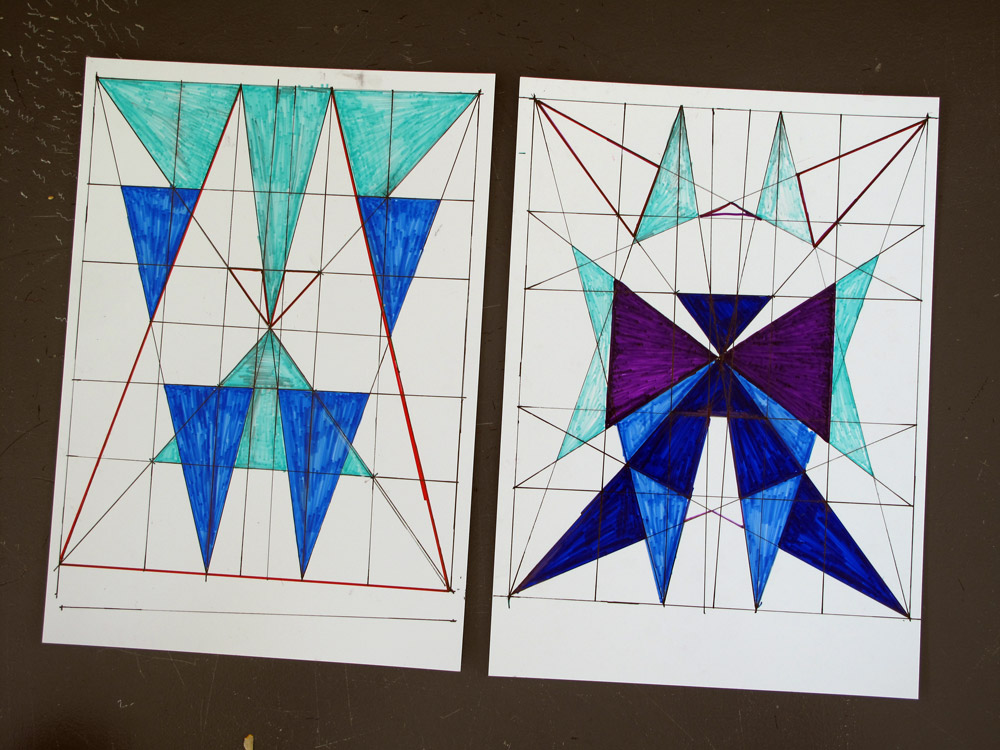
Today I continued with the drawing which was posted last Thursday April 8. Different lines can be drawn on the paper through the diagonals. Horizontal and vertical dividing lines are drawn on the crossings of diagonals. By going on a dense pattern of horizontal, vertical and diagonal lines will be created, which is like a mist, the subject or object can appear through this web of lines. The sculpture is in the stone, free it from the prison of the monolith, the drawing is on the paper, make it visible by accentuating or erasing in the web of lines.
While drawing it was wonderful to recognize the possibility to draw a "river down below" after a painting of Jan Andriesse.


Left premature drawing is more or less after a drawing of Karel Martens. The drawing on the right is after the painting "the river down below" of Jan Andriesse.
Probably it is possible to continue with the surface research project by scratching and drawing over it again as done in the palimpsest drawings. The palimpsest here is not a layered text drawing but is working with patterns and directions.
Questions are rising, how strict a method has to be followed? To draw after a system, how far to continue and when do you liberate yourself? Anything goes? Repeatedly going back to the basic question.

Thursday, 8 April 2010

surface research summary


Golden ratio or golden proportion construction drawn with ink on an A4 sheet of paper.


Three exploratory drawings after the golden proportions. Each drawing is drawn on an A4 sheet of paper.


Three drawings about a reduction construction. The square and the two rectangles have the same number of square centimetres = 441 cm2. Sitting, standing and lying formats. To get grip on the surface with specific proportions. By drawing the square and the rectangle diagonals cross points makes it possible to construct the grid with a reduction to the corner were the two diagonals meet.


Three drawings about a construction of a square and the two rectangles with the same number of square centimetres = 441 cm2. Sitting, standing and lying.


After the 9 palimpsest drawings, which is a series on its own, I had to go back to the basic question what a surface is. A specific surface of paper, necessary as subsurface to draw on. Until now I defined 6 properties for the drawing surface :

1. two dimensional
2. size and proportion
3. shape
4. colour
5. materiality
6. texture

The 13 drawings shown here are about the two dimensional surface with a certain size. Different lines can be drawn on the paper through the diagonals. Horizontal and vertical dividing lines are drawn on the crossings of diagonals. By going on a dense pattern of horizontal, vertical and diagonal lines will be created, which is like a mist, the subject or object can appear through this web of lines. The sculpture is in the stone, free it from the prison of the monolith, the drawing is on the paper, make it visible by accentuating or erasing in the web of lines.

Thursday, 1 April 2010

workshop for 2 participants


Yesterday the second workshop was going on in the Pavilion. It was quite a disappointment that only two participants showed up. As organiser I am asking myself if it is that boring to draw after certain rules? Is it that rigid or stupid to draw after a plan which is going about the surface with it's specific properties? Difficult to know when almost everybody who signed in for the workshop stay at home.
How to get the attention of the participants? It isn't sexy to tell them that when boredom is coming up while drawing it is good to continue with the original idea or plan. To tell them it can be quite good to switch off the ego with it's superficial demands. Deny the first emotions of despair, laziness and boredom and conquer yourself. Perhaps than it is possible to get fascinated by the interesting problems which are there while drawing. Try to pay attention to the drawing process, try to remember how decisions are made, try to foresee and to anticipate the possibilities nearby.
So the next workshop I am going to offer free beer, good music and champagne in the afternoon to the participants who want to try to go beyond the first superficial emotions that are the
obstacles for starting and continuing with a drawing.
It sounds as a session of psychotherapy...
The photo herewith is a workshop drawing made yesterday by
René van Heel. He drew after the specific method of construction to become a rectangle with the proportions of the Golden Ratio.

Tuesday, 30 March 2010

continuing drawing with golden ratio


1


2


3

Started to play with the possibilities, three photo's above are showing the changing drawings. Continuing drawing is playing with possibilities already there when the first line is drawn. It is also a fight against boredom and laziness. Tomorrow during the workshop "intensive drawing" after this material about the golden ratio, I am curious how many participants can stay awake.
The best thing to do is to switch of or to eliminate the ego, so drawing itself can go on without sighs. A bit of desperation is the right mood to execute a drawing not foreseen and not existing until now.

Monday, 29 March 2010

the surface and its dimensions


The surface, I am trying to focus on the surface and its dimensions. For that reason it is nice to be able to use the balanced proportions of the golden ratio. The dimensions of a golden ratio sheet of paper that is locked up in an A4 sheet of paper is quite smaller than an A4. The photo up here shows some A4 sheets of paper, 2 golden ratio sheets of paper and three sit, lie & stand sheets of paper cut to proportions with the same square centimetres. An A4 has the dimensions 29,7 x 21 centimetres, a golden ratio sized sheet of paper cut from an A4 sheet of paper has the dimensions 29,7 x 18,4 centimetres.


To construct the golden ratio rectangle it is necessary to use a square. The square is an integral part of a golden ratio rectangle. Drawing the construction lines already there through connecting edges and continuing drawing from crossing lines is easy, no inspiration or special skills are necessary. The drawing is in the paper like the sculpture is in the stone.


Drawn on Epson Premium Glossy Photo paper with its glossy coating. Playing with the possibilities is started, erasing and scratching into the paper is part of the game. Golden ratio and palimpsest techniques are subject of research, of practical artistic research.

Thursday, 25 March 2010

golden ratio


Next Wednesday, march 31 2010, during the workshop "intensive drawing" I would like to propose that we are going to work with the "golden ratio". To inform what the "golden ratio" means herewith the wikipedia explanation :

http://en.wikipedia.org/wiki/Golden_ratio

The drawing above of the rectangle is constructed after the golden ratio, starting with a square of 21 x 21 cm. The drawing is made on a A3 sheet of paper : 42 x 29,7 cm. The golden ratio rectangle on the A3 sheet of paper has the dimensions 34 x 21 cm. I think this is the smallest golden ratio rectangle with natural numbers.
To bore and burn, to stand and fall, to unite and divide.