Showing posts with label kepler triangle. Show all posts

Thursday, 15 April 2010

Kepler Triangle


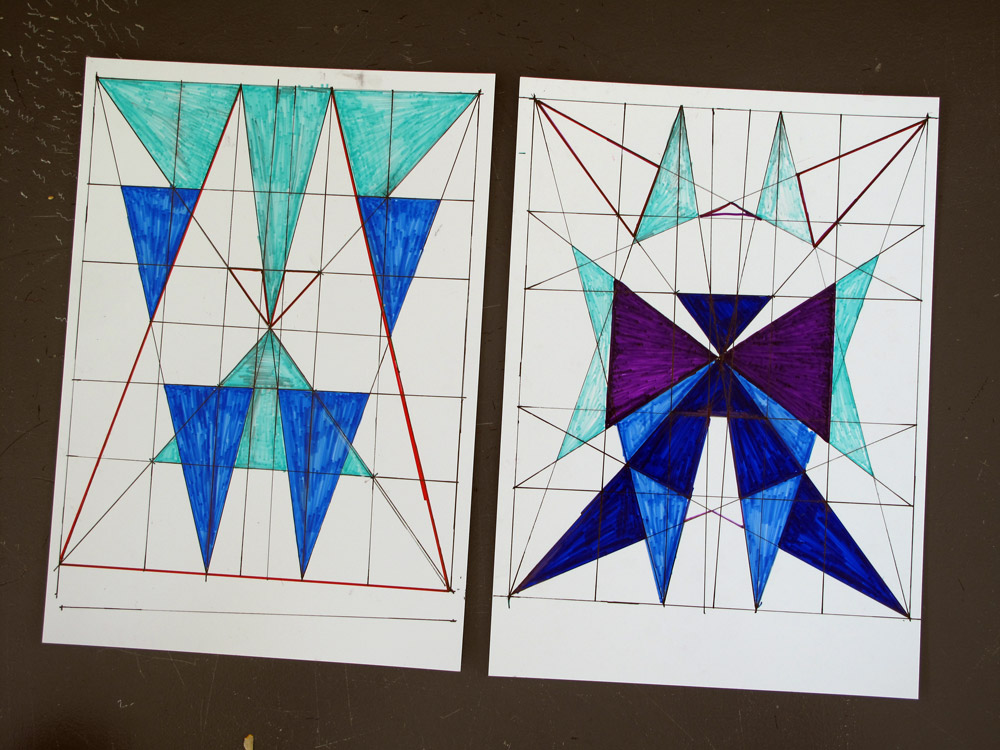
Last Wednesday Jan Andriesse gave me a A4 sheet of paper with the construction of the Triangle of Kepler and the rectangle where the triangle is the half part from. The ratio of the edges of a Kepler triangle are linked to the golden ratio and can be written approximately as 1 : 1.2720196 : 1.6180339. The German mathematician and astronomer Johannes Kepler (1571–1630) expressed in the following quotation his deep fascination for the Pythagorean theorem and the golden ratio: "geometry has two great treasures: one is the theorem of Pythagoras, the other the division of a line into mean and extreme ratio. The first we may compare to a mass of gold, the second we may call a precious jewel".


Four photo's of the evolution of the same drawing with the construction of the triangle of Kepler. Next week the drawing will evolve into a more complex drawing. I think it is going to be a first drawing of a series of drawings where the palimpsest principle of drawing and scratching, of creation and destruction, will be practised.

workshop number three


Yesterday, Wednesday April 14, the third workshop "intensive drawing" was held. Not many participants, but the participants there worked quite intensively with the rectangular grids of the golden ratio. We also worked with the proportions after the triangle of Kepler.
I was glad one of the teachers from the graphic department joined the workshop. I am not sure but a difference between departments where students have to do assignments like the graphic or the textile department and departments without commissions like fine arts, where the student has to explore his or her individuality, it is quite hard for them to work after an assignment. I don't want to generalise and I would like to know it better if students from fine arts, where they have to go deep into themselves, if they are less flexible to work after a system or assignment than students from departments which are more specific and concrete like graphic arts.
Drawing after a system or assignment which is given by someone, it isn't necessary to have ideas while working. You can build up a concentration where you discover the possibilities in the system and new inventions can happen.
You have to start.
Try to define some rules to start with.
Or try to be as precise as possible to visualise the principle idea.
The first and quick result doesn't matter.
Know that it is better to foresee a series of drawings to explore the principle or idea.
And try to get rid of personal taste and prejudices.


Two drawings of Luna Maurer, while drawing she got infected with the "there are so many possibilities microbe".


Two drawings of Rosa Doornenbal, she worked with the proportions construction of the triangle of Kepler. Because she likes the most the triangle, and dislikes the square and circle. Therefore it will be a challenge for Rosa to draw with parts of the circle next time.

Wednesday, 14 April 2010

visiting Jan Andriesse


As homage to Piet Mondriaan and to possess a Mondriaan himself the painter Jan Andriesse copied Mondriaans "composition with yellow lines" (1933 / 80 x 80 cm / Haags Gemeentemuseum) as precise as possible. By copying it he studied it and he found some remarkable details about the small painting. The yellow line on the left and the yellow line on top these lines have the same width. If they are continued outside the painting they form a square as is to see in the small drawing on the left bottom corner. Mondriaan said he didn't use mathematical systems to construct his paintings, he worked directly with his intuition on the canvas by drawing with charcoal the compositions he had in mind. It could take weeks and sometimes months to make corrections and the composition was crystallized enough to start with painting colours. For Jan Andriesse it was also the most difficult task to do, mixing the right yellow colour.

Bottom left corner of the photo a small poster of German propaganda : "British planes have no mercy for peaceful citizens, therefore stay at home".


Yesterday I visited Jan in his studio boat on the Amstel river. I had to because he is one of the rare artists who is working with the golden ratio. Yesterday afternoon he explained to me the triangle of Kepler. A triangle Jan Andriesse discovered quite some time ago when he was living in New York. He used to paint on a rectangle with the proportions 1 : 1,25. Slowly the proportions of the rectangle changed in 1 : 1,27. By reading and studying he discovered Kepler and his triangle with the proportions of 1 : 1,272.
Thank you Jan for explaining Kepler's triangle. For explaining Barnet Newman's wide rectangles. For telling many interesting stories about mathematics and philosophy. For the gossip and the one liners : "stay at home, read Baruch..."


The sine wave or sinusoid is a mathematical function that describes a smooth repetitive oscillation. On the photo there are 9 moulds or templates Jan Andriesse made with the sinusoid that represents the decreasing wave of water when it is split by a boat or duck. Jan tried to make paintings with the 9 beautiful templates but he failed again and again. The reason why was explained by Jan by a quote of T. S. Eliot : "by dreaming of systems so perfect that no one will need to be good". The 9 templates finally delivers paintings which are simply too beautiful, too boring, too perfect. The human irrational disappeared and therefore the result is dissatisfying.


On the studio wall of Jan Andriesse : a rectangle after the triangle of Kepler, one of the diagonals in the rectangle which is from the same length as the elegant hanging chain bow.
Less is more, stay at home, read Baruch ...