Wednesday, 19 May 2010

new surface with fertilised soil


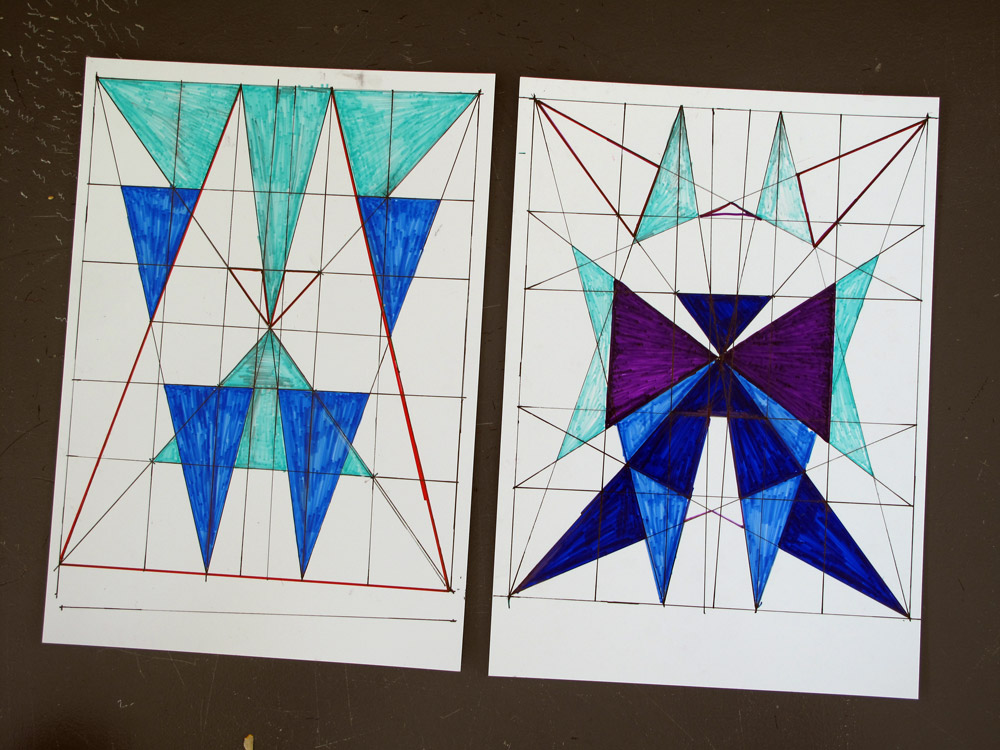
To get grip on the matter of art and destruction I would like to start up a new cycle of palimpsest drawings. The photo shows a drawing on Epson photo paper with the proportions of the golden ratio. The triangle of Kepler is drawn and with a small letter template letters which form words are sown to fertilise the surface.
To do some theoretical study on the subject this afternoon I have to go to the library of the Rijks Academy in Amsterdam. To borrow the book "the destruction of art" by Dario Gamboni.

Tuesday, 18 May 2010

the destruction of art


Barnett Newman's "who is afraid..." and "cathedra" both cut up in the Stedelijk Museum Amsterdam some time ago.
The destruction of art & the art of destruction aren't two sides of the same coin. Trying to evoke the destructive element in creating art is difficult. Creating drawings is a quite positive act and perhaps a positive belief. It can be done with negative feelings like being bored, feeling ugly, stupid, lazy, ill, sad and mad. Working with destruction is a sentiment difficult to make clear. Destruction as part of creating new drawings. Violence and vandalism should be part of the final drawing. Soon I expect to make it clear.

Monday, 17 May 2010

encore trois semaines


Within three weeks my Surface Research project has had it's first year. Much too short and it passed away like a cigarette in smoke. Fast, pleased with the prospect but finally dissatisfying when the end is near. Why? Because many questions aren't answered, the subject of the destructive element in creating art pieces isn't yet clear to me. The palimpsests and the specific texts used in the palimpsests were a start that dealt with construction and destruction. Precise construction by drawing the texts in grids using a ruler and compasses, well kept in hand destruction by scratching out the texts with a cutter.
After that I made a step backwards by working with specific conditions of a surface which is going to be used for drawings. It was necessary that dimensions had a reason and that is why I worked with the Golden Ratio and the Triangle of Kepler. Again many possibilities in drawings and the destruction of the drawings has been invested.
In the final three weeks I am going to make some new "destructed" drawings to complete the exhibition I am planning for Monday May 31 till Thursday June 3 in the Rietveld pavilion.

Invitation card will be posted soon on this blog.

Thursday, 22 April 2010

construction and destruction again


To destroy, to demolish, to annihilate, to damage is necessary to conquer the despair of being locked up in boring and stupid old problems. Creating drawings or paintings is a fight with yourself against the inner stupidity, laziness and boredom. In the battle of an idea and its materialization something has to be overcome by destroying the well known solutions already used before.
Mondriaan's quote: "I think the destructive element is very much neglected in art" is difficult to understand because his oeuvre looks so logic, solid and form from a steady evolution. But he had to conquer his own figurative work by destroying the figurative image to reach abstraction. And in his abstract paintings he was in a fight with the black lines. Although painters used coloured lines in abstract compositions before, Mondriaan had to go a long route to "destroy" the black lines in his own paintings. By painting again and again inventive compositions with quite radical decisions where to place the lines. It was a long and essential process, or a heavy fight, somewhere in the intuition of the artist to be able to paint coloured lines. He was looking into a deep black darkness, a presumption of possibilities with his visual idiom. But the battle is never won, the feeling to have to destruct the darlings which delivered such good results is manifest.


Drawing and erasing it, leaving traces, the strong notion it isn't the desired effect, so again destruction by scratching the drawing is the best thing to do. It is a well kept in hand battle. Destruction and construction are on a bascule, no running of the rails, no panicking, steered by intuition and belief. A belief without any religion, the belief in a disenchanted world.

Wednesday, 21 April 2010

destruction & construction summary


Nine different states of the same drawing, the final state is the first image here above. While drawing today during the workshop we talked about construction and destruction. We tried to understand Piet Mondriaan's quote: "I think the destructive element is very much neglected in art". And that is why we made drawings by drawing a construction that had to be destructed afterwards. Tomorrow I am going to write more about this subject. So see you...


Tuesday, 20 April 2010

to destruct & to construct


The drawing which ended yesterday's item about construction & destruction.The eight photo's herewith are from the same drawing. The destruction "evolutes" and finally the drawing has disappeared enough so a new drawing can overwrite the destructed surface.


Monday, 19 April 2010

creation & destruction


First state of Thursday April 8. Seven states of the same drawing are shown here, because I would like to show creation and destruction. To be continued tomorrow...


On a sheet of paper with proportions of the golden ratio I constructed with diagonals, cross points, horizontal lines, vertical lines and lines drawn with the compasses a web that is very dense.
It is possible to accentuate a pattern in the web, or to draw a composition with the web of guide lines. Foreseeing it is going to be a composition for destruction. By scratching it out with hatch lines all over.
Afterwards I want to try to start a new drawing over the destructed drawing. In one day : construction - destruction & construction again.

According to Piet Mondriaan : "I think the destructive element is very much neglected in art".

Thursday, 15 April 2010

Kepler Triangle


Last Wednesday Jan Andriesse gave me a A4 sheet of paper with the construction of the Triangle of Kepler and the rectangle where the triangle is the half part from. The ratio of the edges of a Kepler triangle are linked to the golden ratio and can be written approximately as 1 : 1.2720196 : 1.6180339. The German mathematician and astronomer Johannes Kepler (1571–1630) expressed in the following quotation his deep fascination for the Pythagorean theorem and the golden ratio: "geometry has two great treasures: one is the theorem of Pythagoras, the other the division of a line into mean and extreme ratio. The first we may compare to a mass of gold, the second we may call a precious jewel".


Four photo's of the evolution of the same drawing with the construction of the triangle of Kepler. Next week the drawing will evolve into a more complex drawing. I think it is going to be a first drawing of a series of drawings where the palimpsest principle of drawing and scratching, of creation and destruction, will be practised.

workshop number three


Yesterday, Wednesday April 14, the third workshop "intensive drawing" was held. Not many participants, but the participants there worked quite intensively with the rectangular grids of the golden ratio. We also worked with the proportions after the triangle of Kepler.
I was glad one of the teachers from the graphic department joined the workshop. I am not sure but a difference between departments where students have to do assignments like the graphic or the textile department and departments without commissions like fine arts, where the student has to explore his or her individuality, it is quite hard for them to work after an assignment. I don't want to generalise and I would like to know it better if students from fine arts, where they have to go deep into themselves, if they are less flexible to work after a system or assignment than students from departments which are more specific and concrete like graphic arts.
Drawing after a system or assignment which is given by someone, it isn't necessary to have ideas while working. You can build up a concentration where you discover the possibilities in the system and new inventions can happen.
You have to start.
Try to define some rules to start with.
Or try to be as precise as possible to visualise the principle idea.
The first and quick result doesn't matter.
Know that it is better to foresee a series of drawings to explore the principle or idea.
And try to get rid of personal taste and prejudices.


Two drawings of Luna Maurer, while drawing she got infected with the "there are so many possibilities microbe".


Two drawings of Rosa Doornenbal, she worked with the proportions construction of the triangle of Kepler. Because she likes the most the triangle, and dislikes the square and circle. Therefore it will be a challenge for Rosa to draw with parts of the circle next time.

Wednesday, 14 April 2010

visiting Jan Andriesse


As homage to Piet Mondriaan and to possess a Mondriaan himself the painter Jan Andriesse copied Mondriaans "composition with yellow lines" (1933 / 80 x 80 cm / Haags Gemeentemuseum) as precise as possible. By copying it he studied it and he found some remarkable details about the small painting. The yellow line on the left and the yellow line on top these lines have the same width. If they are continued outside the painting they form a square as is to see in the small drawing on the left bottom corner. Mondriaan said he didn't use mathematical systems to construct his paintings, he worked directly with his intuition on the canvas by drawing with charcoal the compositions he had in mind. It could take weeks and sometimes months to make corrections and the composition was crystallized enough to start with painting colours. For Jan Andriesse it was also the most difficult task to do, mixing the right yellow colour.

Bottom left corner of the photo a small poster of German propaganda : "British planes have no mercy for peaceful citizens, therefore stay at home".


Yesterday I visited Jan in his studio boat on the Amstel river. I had to because he is one of the rare artists who is working with the golden ratio. Yesterday afternoon he explained to me the triangle of Kepler. A triangle Jan Andriesse discovered quite some time ago when he was living in New York. He used to paint on a rectangle with the proportions 1 : 1,25. Slowly the proportions of the rectangle changed in 1 : 1,27. By reading and studying he discovered Kepler and his triangle with the proportions of 1 : 1,272.
Thank you Jan for explaining Kepler's triangle. For explaining Barnet Newman's wide rectangles. For telling many interesting stories about mathematics and philosophy. For the gossip and the one liners : "stay at home, read Baruch..."


The sine wave or sinusoid is a mathematical function that describes a smooth repetitive oscillation. On the photo there are 9 moulds or templates Jan Andriesse made with the sinusoid that represents the decreasing wave of water when it is split by a boat or duck. Jan tried to make paintings with the 9 beautiful templates but he failed again and again. The reason why was explained by Jan by a quote of T. S. Eliot : "by dreaming of systems so perfect that no one will need to be good". The 9 templates finally delivers paintings which are simply too beautiful, too boring, too perfect. The human irrational disappeared and therefore the result is dissatisfying.


On the studio wall of Jan Andriesse : a rectangle after the triangle of Kepler, one of the diagonals in the rectangle which is from the same length as the elegant hanging chain bow.
Less is more, stay at home, read Baruch ...

Tuesday, 13 April 2010

influences & inspirations


Drowning in possibilities, lost in ambiguities, disorientated, lack of structure, therefore indecision and desperation during drawing something unforeseen.
This drawing is inspired by Mondriaan and Andriesse, I am going to visit Jan Andriesse to know more. Perhaps afterwards it is possible to work systematically with the knowledge for another chapter "surface research".

Monday, 12 April 2010

influences


Today I continued with the drawing which was posted last Thursday April 8. Different lines can be drawn on the paper through the diagonals. Horizontal and vertical dividing lines are drawn on the crossings of diagonals. By going on a dense pattern of horizontal, vertical and diagonal lines will be created, which is like a mist, the subject or object can appear through this web of lines. The sculpture is in the stone, free it from the prison of the monolith, the drawing is on the paper, make it visible by accentuating or erasing in the web of lines.
While drawing it was wonderful to recognize the possibility to draw a "river down below" after a painting of Jan Andriesse.


Left premature drawing is more or less after a drawing of Karel Martens. The drawing on the right is after the painting "the river down below" of Jan Andriesse.
Probably it is possible to continue with the surface research project by scratching and drawing over it again as done in the palimpsest drawings. The palimpsest here is not a layered text drawing but is working with patterns and directions.
Questions are rising, how strict a method has to be followed? To draw after a system, how far to continue and when do you liberate yourself? Anything goes? Repeatedly going back to the basic question.